
Blocks and Streets Extraction
Blocks and Streets Extraction from Satellite and Aerial imagery
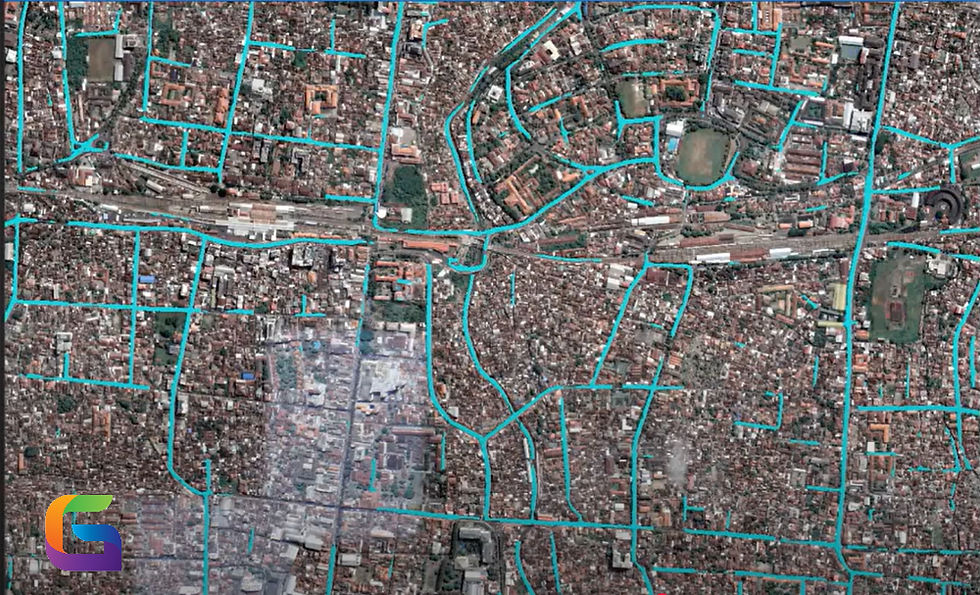
Use an advanced deep learning algorithm to automatically extract urban blocks and street networks from 1-meter aerial and satellite imagery with a resolution of 1 meter per pixel. Specifically developed to detect and map important features in the urban infrastructure, the model is intended for use by GIS practitioners, mapping teams, urban planners, and geospatial analysts when converting imagery to analysis-ready mapping data.
Typically, to extract street networks and urban blocks from aerial or satellite imagery, manual digitization of the imagery was needed. The process is usually labor-intensive and difficult to automate over large areas. It may also result in discrepancies between various datasets and different interpreters. Using the latest computer vision and deep learning technology, the model is capable of automatic detection and extraction of streets and urban blocks, thus minimizing manual intervention and making workflows more efficient.
The model recognizes spatial characteristics, forms, patterns, and other aspects of the imagery to distinguish urban streets and blocks. The detected features can be easily incorporated into GIS processes and used to build base maps, transport layers, urban mapping datasets, and other geospatial visualization products.
The use of automated methods for the extraction of blocks and streets becomes especially important in cases when large amounts of mapping need to be done because thousands of blocks and streets need to be digitized automatically. Such automated processes can be used in various applications including urban planning, transportation analysis, infrastructure mapping, land use studies, development of smart cities, disaster response, location-based analysis, and others.
This automation of feature extraction makes the work of geospatial analysts more efficient since it helps save time, which can be spent on further analysis and decision-making and not on feature extraction. Vector-based mapping layers that become the result of this process can become a good basis for map updates and database updates as well as spatial analysis.
Whether you are digitizing streets and blocks in one urban area or you are doing a large-scale mapping project, using our deep learning solution for street and block extraction will become easy and fast.