
Hydrography
The geographic representation and analysis of water bodies such as lakes, rivers, and streams, fundamental for hydrological modelling and watershed analysis.
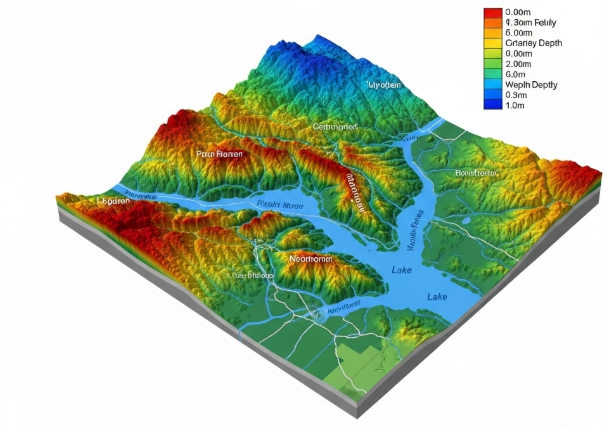
What does Hydrography study?
The scientific study and measurement of the physical characteristics of bodies of water, such as rivers, lakes, seas, and coastal regions, is known as hydrography. It focuses on charting and examining depths, tides, currents, the structure of the seafloor or riverbeds, and the underwater landscape (bathymetry).
Hydrography's primary objectives are to:
Create nautical charts to ensure safe travel.
Encourage dredging and marine construction.
Keep an eye on the maritime and coastal habitats.
Support the management of water resources and flood control
Essentially, hydrography offers comprehensive data on aquatic ecosystems to facilitate safe navigation and sustainable water resource use.
For more information or any questions regarding our services, please don't hesitate to contact us at
Email: info@geowgs84.com
USA (HQ): (720) 702–4849
India: 9009471866 - Jay Sharma
Canada: (519) 590 9999
Mexico: 55 5941 3755
UK & Spain: +44 12358 56710
In order to ascertain depths, seabed features, tides, and currents, hydrographic survey services entail charting and examining bodies of water. By delivering precise and comprehensive underwater data, these surveys—which make use of cutting-edge technology like sonar, LiDAR, and GPS—support environmental research, dredging, coastal management, marine development, and navigation safety.
The technique of measuring and mapping the underwater topography of rivers, lakes, seas, and oceans is known as bathymetric mapping. For navigation, marine research, coastal management, and resource exploration, it offers comprehensive information on water depth, undersea features, and seafloor contour. Sonar, LiDAR, and satellite data are frequently used in modern methods to provide precise, high-resolution mapping.
Single-beam sonar measures depth along a single line beneath a vessel, while multibeam sonar maps wide swaths of the seafloor, providing faster and more detailed 3D bathymetry.
Without the need for human assistance, autonomous hydrographic surveys employing USVs (Unmanned Surface Vehicles) and AUVs (Autonomous Underwater Vehicles) allow for effective, high-precision mapping of water bodies. Compared to conventional approaches, these devices save money, hazards, and survey time while gathering bathymetric, environmental, and navigational data for uses like environmental monitoring, port inspections, and seabed mapping.