
What is Geospatial Engineering? A Complete Guide for 2025
The foundation of today's digital revolution is geospatial engineering, which enables sectors to use location intelligence to make more informed decisions. In 2025, geospatial engineering will have become essential for industries like mining, urban planning, defence, logistics, agriculture, and climate science by combining surveying, remote sensing, GIS (Geographic Information Systems), GNSS (Global Navigation Satellite Systems), photogrammetry, and advanced data analytics.

What is Geospatial Engineering?
Geospatial engineering is a multidisciplinary field focused on capturing, processing, analysing, and managing spatial data related to the Earth’s surface and subsurface. It combines traditional surveying with modern technologies such as:
Remote sensing is the use of satellites and aerial photography to monitor infrastructure, environmental change, and land use.
Software frameworks for storing, evaluating, and visualising spatial data are known as GIS (Geographic Information Systems).
High-precision positioning for mapping, navigation, and real-time asset tracking is provided via GNSS and GPS.
LiDAR and photogrammetry allow for 3D modelling of natural resources, buildings, and terrain.
UAVs and drones: quick, high-resolution data collecting at a lower risk and expense.
AI & Big Data: Advanced analytics for automated feature extraction, geostatistics, and predictive modelling.
Core Components of Geospatial Engineering in 2025
Mapping and Surveying
With GNSS and UAV-based photogrammetry, traditional land surveying is improved.
Centimetre-level accuracy is guaranteed via real-time kinematic (RTK) GPS.
Satellite imagery and remote sensing
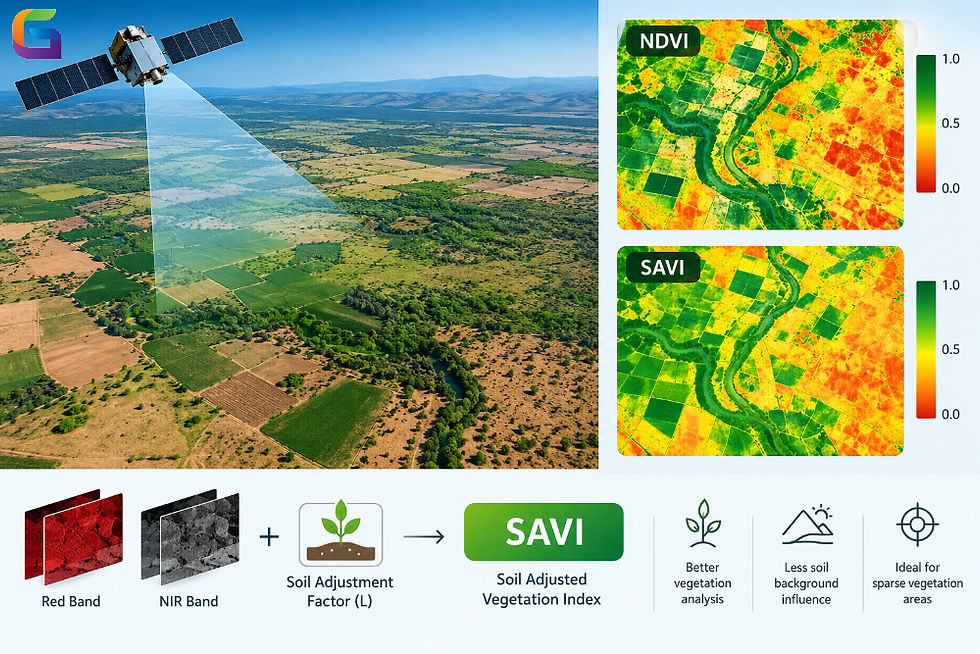
SAR (Synthetic Aperture Radar) and hyperspectral satellites are frequently used in agriculture, disaster relief, and climate monitoring.
Petabytes of Earth observation data may be accessed whenever needed thanks to cloud-based technologies.
Data Management & GIS
IoT, ERP, and digital twins are all integrated with cloud-native GIS systems.
Operational intelligence is supported by real-time geospatial dashboards.
Modelling in 3D and 4D
Digital twins of cities, mines, and building sites are provided using LiDAR and drone photogrammetry.
Time-enabled (4D) GIS monitors infrastructure and landscape change detection.
Automation & AI
Mineral detection, crop health analysis, and land classification are all automated by machine learning algorithms.
Drones equipped with Edge AI allow for on-site data processing without the need for connectivity.
Future Trends in Geospatial Engineering (2025 and Beyond)
Integration with Digital Twins: To model and improve real-world systems, smart cities and industry are utilising 3D geographic data.
5G & IoT Connectivity: Millions of IoT devices are now able to stream geographical data in real time thanks to fast networks.
According to a preliminary study, quantum computing in GIS could significantly speed up the analysis of spatial data.
Edge AI for Geospatial Data: Before being transmitted, data will be automatically processed and filtered by sensors and UAVs.
Pay-as-you-go, scalable geospatial cloud services are making satellite and UAV datasets more accessible to anyone.
Why Geospatial Engineering Matters in 2025
Ninety percent of corporate and government choices are location-dependent in a world that is becoming more interconnected by the day. Geospatial engineering offers the data infrastructure for more intelligent strategies and sustainable growth, from supply chain optimisation to climate resilience. Businesses that make geospatial intelligence investments obtain a competitive advantage by:
Cutting back on operating expenses
Increasing the distribution of resources
Improving compliance and safety
Facilitating Innovation Driven by Data
By 2025, geospatial engineering will have evolved beyond creating maps to include creating an intelligent ecosystem that combines real-time data, artificial intelligence, and location intelligence. The future is for those who can use geospatial technologies to get operational excellence and predictive insights, whether in mining, smart cities, or agriculture.
For more information or any questions regarding the geospatial analysis, please don't hesitate to contact us at
Email: info@geowgs84.com
USA (HQ): (720) 702–4849
(A GeoWGS84 Corp Company)


Comments