
What Is Time Series Analysis? A Complete Beginner’s Guide
- 6 hours ago
- 5 min read
Organizations use Geographic Information Systems (GIS) to conduct analyses based on geospatial data. This means they are using these types of tools to examine how geographic features are distributed across space (the physical location of an object) and how those same features are distributed over time (their ability to change).
To analyze and interpret both of these aspects together, we use Time Series Analysis (TSA) to combine both types of data together. TSA allows us to use both geospatial information and temporal information to perform many different types of analyses, including: monitoring geographic changes over time, identifying trends, detecting anomalies, forecasting future conditions, and supporting evidence-based planning.
Some examples of using TSA in GIS would be: studying the effects of urban sprawl, climate change, crop health, and natural disaster occurrences through both geospatial and temporal data.
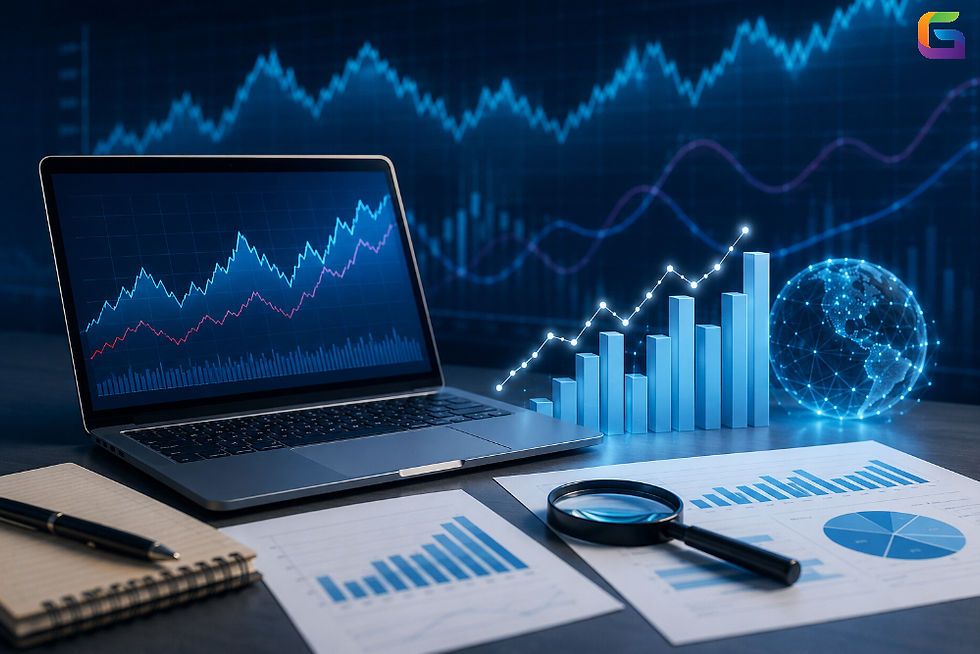
What Is Time Series Analysis?
Examining data collected over time (time series analysis) to determine patterns, trends, and seasons, and evaluate long-term changes.
Rather than only analysing one point-in-time source of geographic data, analysts will also examine many time-based observations (captured over the course of days, months, years or even decades).
A typical set of time-based observations or time series data might include:
Satellite imagery acquired every 5 days.
Daily precipitation readings
Monthly average land surface temperatures
Annual land cover maps
Weekly traffic counts
Hourly air quality data
By using the time series aspect of the data, analysts can answer questions such as:
How much have plants changed over the last 10 years?
Is urbanisation occurring more quickly?
Where do areas have seasonal flooding?
Where is deforestation happening the fastest?
What are the trends being observed in the depletion of groundwater?
What Is Time Series Analysis in GIS?
Time Series Analysis in Geographic Information Systems (GIS) involves evaluating geographic data recorded on more than one occasion to see how spatial features can change over time.
Time Series GIS differs from traditional GIS analyses by using historical data taken as a continuous series of observations to look at:
e.g., Long-term linear trends
Spatial shifts in location and shape over time
Seasonal, annual, or other recurring patterns in data
Changes to the environment
Predictive forecasts of future phenomena
The above data create the four-dimensional (4D) view - or, as it is commonly called, spatio-temporal view - of phenomena, consisting of:
(X) Latitude
(Y) Longitude
(Z) Elevation
(t) Time
Why Is Time Series Analysis Important
The geographic landscape is always changing.
Some examples include:
Expire and generate trees.
Rivers periodically change course.
Urban areas continue to grow.
Glaciers are melting.
Crops go from kohlrabi to harvestable.
Traffic on highways has increased over time.
The weather continues to change.
However, when analyzing just one point in time, it can lead to incomplete or sometimes controversial conclusions.
Time Series GIS can be used by organizations to:
Identify slow-moving environmental changes.
Measure the effectiveness of public infrastructure.
Measure some types of land cover change.
Promote effective emergency response.
Provide reliable information on future space conditions.
Support and/or encourage sustainable development.
How Does Time Series Analysis Work
All standard workflows consist of multiple stages.
Stage 1: Data Gathering
Collect datasets broken down into time periods.
Data source examples include:
Imaging from satellites (imagery)
Drones used to capture aerial surveys.
GPS devices
Weather Stations
Ground-based observations and measurements
Stage 2: Data Preprocessing
Raw data needs to go through a cleaning process before being useful.
Common cleaning procedures for raw data include:
Removing atmospheric effects (atmospheric corrections)
Removing clouds (cloud removal)
Filtering noise from the dataset (noise filters)
Standardizing projections of data (projection standardization)
Aligning images with others based on geographic location (spatial alignment)
Handling missing data (handling missing values)
Stage 3: Temporal Stacking
Create a stack of the previous image(s) based on the most recent data collected.
Examples:
2020 → 2021 → 2022 → 2023 → 2024
Stages one through three create a temporal database for later analysis.
Stage 4: Extracting Variables from Images
Variables that can be determined from the features of images usually are:
Land Surface Temperature
Water (Water Index)
Urban Area
Forest Cover
Change of Elevation
Stage 5: Trend Analysis
Using statistical methods to identify how values are changing over time.
Trends can be:
Increasing
Decreasing
Staying the Same
Cyclic
Seasonal
Stage 6: Displaying Results
Displaying results using the following methods:
Maps with time enabled.
Animated maps using GIS
Heat Maps
Temporal Dashboards
Interactive Charts
Popular GIS Software for Time Series Analysis
Many GIS platforms include temporal analysis functions as part of their offerings.
ArcGIS Pro
Some of the features that come with ArcGIS Pro are:
Time Slider
Space-Time Cube
Emerging Hot Spot Analysis
Temporal Visualization
QGIS
QGIS also allows for temporal analysis; you can do this by utilizing:
Temporal Controller
Time Manager Extensions/Plugins
Raster Calculator
Processing Toolbox
Google Earth Engine
These tools are usually utilized for:
Large archive of satellite imagery
Cloud computing
NDVI analysis
Global monitoring
Python Libraries
To perform temporal analysis with Python, many libraries can assist you in conducting this type of analysis, such as:
Benefits of utilizing time series analysis include:
There are many benefits of using Time Series Geographical Information Systems (GIS) for organizations:
Improved trend detection
Enhanced forecasting accuracy
Historical comparisons
Early detection of anomalies
Improved decision-making
Automated monitoring
Reduced operational costs
Improved risk assessment.
Challenges of Time Series GIS
Despite the advantages, analysts can experience some difficulties associated with:
Missing observations
Cloudy satellite imagery
Large amounts of data
Differences in sensors
High levels of computational complexity
Data quality issues
Incorrect spatial alignment
Temporal gaps.
New technologies, such as cloud computing and artificial intelligence (AI) based preprocessing techniques, are supporting the resolution of many of these limitations.
Future of Time Series Analysis in GIS
Investments in emerging technologies will help create an environment that allows for faster and deeper analyses to be conducted using datasets available through time-series geospatial analysis; therefore, the future of time-series geospatial analyses is heavily dependent on these ongoing investments.
Current and future investment areas to allow for time-series geospatial analyses include:
Artificial Intelligence (AI) driven change detection;
Deep Learning image classification;
Real-time integration of Internet of Things (IoT);
Digital Twins;
Cloud-Native Geographic Information Systems (GIS);
Edge Computing;
Autonomous Drone Monitoring; and
Predictive Spatial Intelligence.
Time-series analysis will continue to become increasingly critical to support environmental monitoring purposes, urban planning activities, agriculture, transportation, public health and disaster preparedness as Earth observation images are collected at increasing rates and become widely available.
Incorporating the dimension of time into spatial analysis allows organizations to understand where, when, and how geological changes occur using the time dimension, provided that time series analysis can accommodate that functionality. The integration of satellite imagery, sensors, and historical records into predictive models helps GIS practitioners identify meaningful trends and anomalies and develop a better understanding of how their industries function through data-driven decision-making across multiple sectors.
Providing information on environmental change is just one of the many industry sectors that can benefit from time series analysis techniques. Monitoring changes to the environment, optimizing agricultural production, planning more intelligent urban environments, and improving disaster recovery all provide a significant competitive advantage when using time series analysis. As cloud-native GIS solutions, artificial intelligence, and Earth observation systems advance, time series analysis will continue to be a key component of the modern geospatial intelligence and data-driven decision-making framework.
For more information or any questions regarding Time Series, please don't hesitate to contact us at
Email: info@geowgs84.com
USA (HQ): (720) 702–4849
(A GeoWGS84 Corp Company)


Comments